
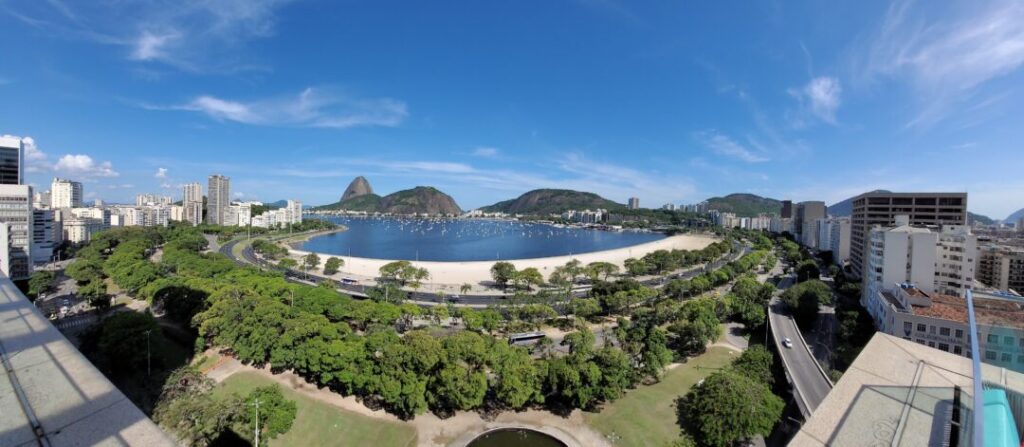
I had the honor to give the closing plenary lecture at the first Latin American Conference in Applied Mathematics, January 30th – February 3rd, 2023 in Rio de Janeiro, Brazil. The talk was based on the results of a three year publicly funded project that constructed, developed and deployed analytical models to understand criminality in the city of Bogota.
The project was executed in collaboration with the Secretary of Security of the City, the National University of Colombia (lead by Professor Francisco Gomez) and the private firm Quantil (lead by myself). Funding acknowledgments are given at the end. *
In this post, I just want to make a short summary of what went into the talk that is, in my opinion, some of the most relevant work we did:
Motivation:
Equilibrium
Prediction models ignore the strategic reaction of criminals. We use unique experimental data and a structural model of crime location (i.e. a discrete choice model), to identify the causal impact of police patrolling on crime. There is a hot discussion on the effects of police patrolling on crime. For example, look at this comprehensive study for the US: David Weisburd and Malay K. Majmundar. 2018. Proactive Policing: Effects on Crime and Communities. Now, in line with our previous topic, some studies have explored the implications of errors in police measurement. For example, Aaron, Ch., and J. McCrary. 2018. Are U.S. Cities Underpoliced? Theory and Evidence; suggest that once we correct for some measurement errors in official statistics, they find that the police elasticity (number of policemen) of violent crime is between -0.289 to -0.361, and for property crime this elasticity is between -0.152 to -0.195. Our study also estimates elasticities, but in a structural model. Also, we focus on the time spent by police at different places in a city, rather than the aggregate number of policemen,
Our estimation strategy capitalizes on the experimental data used in Blattman, Ch., Green, D.,Ortega, D. and S. Tobon. 2021. Place-based interventions at scale: the direct and spillover effects of policing and city services on crime. In this study the authors randomly assigned 756 (206) streets to an 8-month treatment of doubled police patrols (greater municipal services) and measures the direct effect on crime of these interventions. They also measured spillovers (indirect effects) to streets in a radius of 250 meters. Their main result suggest that they can rule out total reductions in crime of more than 2%.
As opposed to Blattman, et.al we use their experimental data to estimate a structural model of crime. That is, we assume citizens can be potential criminals and they derive utility of committing a crime depending on the location of the city (one out of approximately 500 different places), and the police presence at the place. The location is characterized by many urban characteristics (presence of schools, churches, parks, public transportation, etc.). There is also an outside option of not committing a crime which is, the agents majority choice in this model. Given that police presence and criminality are jointly determined, police presence is an endogenous variable in this model and, the dependence of utility on police presence may not be consistently estimated without further considerations. This is where the randomized experiment of Blattman come in, and using their randomized assignment of police time we are able to separate an exogenous component of police presence and use this component to consistently estimate de dependence of crime on police presence.
In agreement with Blatman et.al we find strong direct effects, a mean elasticity of crime to police presence (measured in terms of time spent at a location) of -0.262 for violent crimes, -0.382 for property crime and -0.38 for total crime. Our estimates of spillover effects (i.e., cross location elasticities) are low and close to zero. However, since in our model these spillover effects measure the mean displacement across all locations (not just those at 250 meters) this doesn’t mean that the aggregate spillover effects are small. In fact, preliminary results show that at least in certain kinds of interventions, they can offset direct effects, and in this sense, our model is consistent with Blattman et.al results.
An advantage of using structural models is the fact that we can construct counterfactual scenarios. Our most important result is, therefore, the estimation of the causal impact of different police patrolling strategies (the allocation of time across all locations of the city). In our model we are able to estimate the allocation time, subject to a constraint of invariant aggregate time, that results in the minimum amount of crime. In a nutshell, we show that if police were to be allocated according to our model there would be an aggregate reduction of 7% in violent crimes, 8.5% in property crimes and 5.2% in total crimes. This reduction in crime, especially violent crime, is very important from a social point of view. Even more important because it comes from a more efficient allocation of police time rather than from additional costs.
The complete presentation:
Get information about Data Science, Artificial Intelligence, Machine Learning and more.
In the Blog articles, you will find the latest news, publications, studies and articles of current interest.